

Parrot Cage Cover: A Guide to Safe and Happy Sleep
The first time a parrot wakes the whole house before sunrise, most bird parents ask the same question. “Should I get a cover?”
Maybe your cockatiel startles when the hallway light flips on. Maybe your conure gets chatty the second the TV is still glowing in the other room. Maybe your macaw thinks dawn begins whenever one human opens the fridge. That's normal parrot life, and it's also why sleep setup matters so much.
A parrot cage cover can help, but it's not magic cloth and it's not right for every bird. The primary goal is a safe sleep environment. Darkness matters. Quiet matters. Airflow matters. Behavior matters too. Some parrots relax beautifully with a cover. Others chew it, fear it, or turn that dark little space into a hormonal project.
Good care starts with noticing what your bird is telling you. A cover is one tool. Cage placement, bedtime routine, room lighting, and even your bird's species all matter. If you're also working on your bird's full day and night rhythm, full-spectrum lighting for birds can be part of the bigger picture.
A Good Night's Sleep for Your Feathered Friend
A bedtime routine changes the mood of a home.
When parrots know what evening feels like, they settle faster. The room gets quieter. Movements slow down. The bird stops scanning every sound and shadow. That's the moment a cage cover can become useful. Not as décor, but as a signal that the flock is winding down.
What the cover is really doing
For a prey animal, sleep is vulnerable time. Your parrot may live in a cozy home with toys, foraging bowls, and favorite perches, but instinct still matters. Many birds rest better when they feel less visually exposed.
A cover can help in a few ways:
- It signals bedtime: Same cover, same routine, same hour. Parrots love predictable patterns.
- It softens the room: Less light, fewer visual surprises, less startle.
- It adds privacy: Some birds relax when they don't feel “on display.”
- It supports the whole sleep environment: That includes the cage location, nearby noise, and how much household activity continues after lights-out.
A good sleep setup should make your bird feel safe, not trapped.
The question new owners often miss
The better question isn't “Should I cover the cage?” It's “What helps my bird sleep calmly and safely?”
That answer can look different from bird to bird. A budgie may like partial coverage and a quiet wall-side placement. A cockatoo might shred the cover in record time. An African Grey may do well with a very consistent evening routine and low room activity. A hormonal Amazon may need less den-like setup, not more.
Here's the practical mindset that helps most:
| Sleep need | Helpful option |
|---|---|
| Too much room light | Cover, blinds, or moving the cage |
| Household motion at night | Partial visual blocking |
| Bird startles easily | Predictable bedtime routine |
| Bird chews fabric | Skip the cover and darken the room |
| Bird gets hormonal in enclosed spaces | Use lighter, less enclosed sleep setup |
That's why experienced parrot owners don't judge a cover by how nicely it drapes. They judge it by what happens after the lights go out.
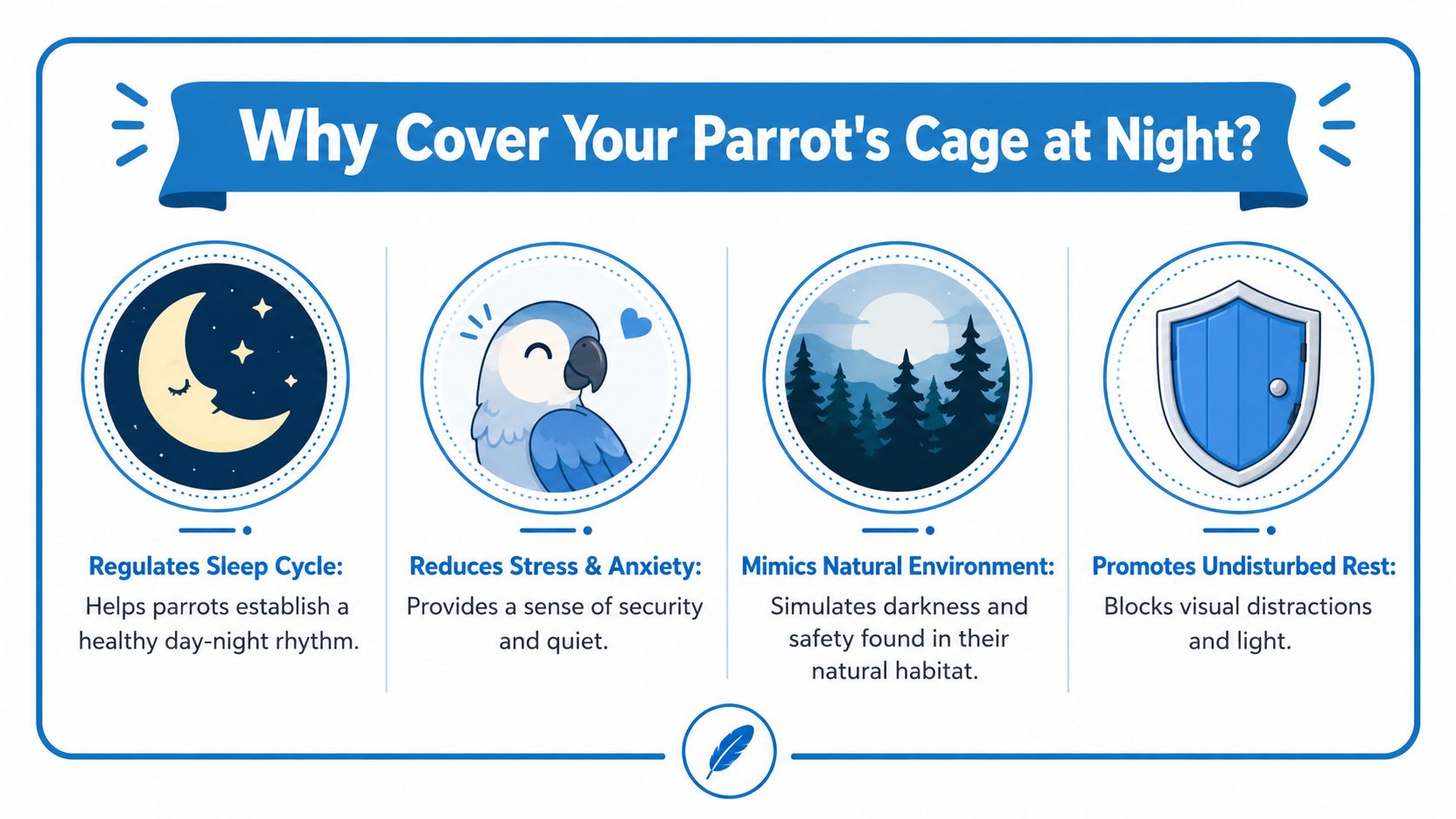
Why You Should Cover Your Parrot's Cage at Night
It is 9:30 p.m., the kitchen light is still on, someone walks past the cage for a glass of water, and your bird keeps lifting one foot, settling, then perking back up. This explains why many owners try a cover. The goal is not just darkness. It is a sleep environment that feels quiet, predictable, and safe.
A well-chosen cover can help some parrots settle by blocking late light, reducing visual activity, and taking the edge off normal household noise. In homes where the bird sleeps in a living room or family area, that can make a real difference.
Better sleep for birds and humans
The practical benefit is simple. A cover can make the room feel less busy.
That matters for parrots that wake at every lamp switch, phone screen, or bit of movement in the room. It can matter for people, too. A bird that rests more soundly is often less likely to call out because the house stayed active long past bedtime.
Still, a cover is only one tool. If the room is cold, drafty, or bright before dawn, the better fix may be changing the environment itself. Some owners get more improvement from blackout curtains, a quieter sleep room, or safe overnight warmth such as a heated perch for birds in cooler rooms than from adding more fabric around the cage.
Why some parrots relax under a cover
Many parrots settle faster when there is less to monitor. Fewer shadows. Fewer passing people. Less reason to stay on alert.
For a bird that lives in the middle of household traffic, partial visual shielding can help the cage feel more protected at night. This is often useful for species that are easily stimulated by movement outside the cage, especially if the bird otherwise sleeps lightly and startles often.
A cover may help when your bird:
- gets stirred up by room light after bedtime
- watches every bit of evening traffic in the house
- sleeps in a shared living space instead of a dedicated bird room
- does better with a more enclosed feeling at night, without becoming possessive or agitated
A cover is not always the right answer
Some parrots do worse with a cover, and owners need to hear that clearly.
Chew-heavy birds such as cockatoos can turn loose fabric into a hazard fast. Birds with hormonal behavior may also become more territorial if the cage starts to feel too enclosed or cave-like. In those cases, darkening the room, turning off screens earlier, moving the cage to a calmer spot, or using partial side coverage is usually safer than fully draping the cage.
I have seen this play out in ordinary homes. One bird relaxes the minute the front and sides are shaded. Another climbs the bars, chews the edge, and treats the whole setup like a nesting project. The right choice depends on what your bird does after lights-out, not on what looks neat in the room.
Sleep support works best as a full setup
Parrots still have strong prey instincts, so nighttime security matters. A cover can support that. It cannot compensate for a poor sleep setup.
Use it if it helps your bird rest without adding risk. Skip it if your bird chews fabric, overheats, gets more hormonal, or sleeps better with the room darkened and the cage left open to airflow. Good parrot care is less about following one rule and more about building the safest sleep environment for the bird in front of you.
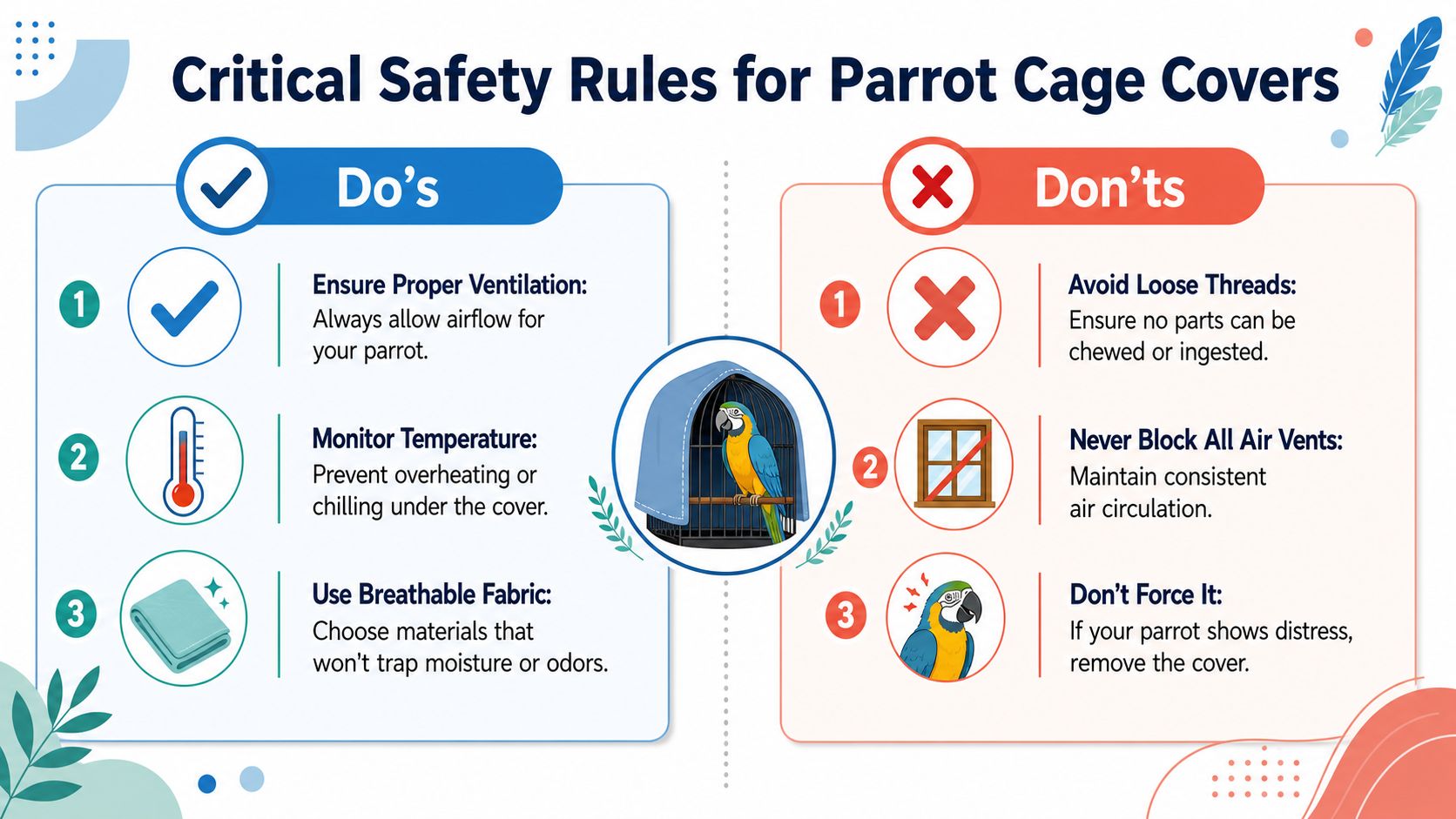
Critical Safety Rules for Using a Cage Cover
Often, articles on this subject become overly cheerful and insufficiently practical. A cover can help. It can also be the wrong choice.
If a cover traps heat, blocks airflow, frays, or turns the cage into a nest-like cave, it stops being a sleep tool and starts becoming a risk. Safety comes before darkness every time.
The biggest mistakes to avoid
Independent bird-care guidance notes that cage covers can encourage nesting behavior and hormonal aggression, and they can also be chewed, ingested, or cause entanglement, especially for large parrots like cockatoos, as explained in BirdTricks' discussion of covering a bird's cage at night.
That matches what many experienced owners see at home. Some birds snuggle down and sleep. Others start treating the cover like a project.
Watch for these problems:
- Chewing at the cover edges: This is a red flag, not a cute quirk.
- Loose threads or holes: Toes and beaks can get caught.
- Panting or stuffiness: The cover may be too heavy or too closed.
- Increased possessiveness or aggression: The covered cage may be acting like a nest site.
- Panic when covered: Some birds feel trapped instead of comforted.
When a cover is the wrong choice
For some parrots, the safer sleep setup is room-darkening blinds or a separate sleep cage in a quieter space. This often makes more sense for strong chewers, birds with a history of hormonal behavior, or parrots that become frantic under fabric.
Cockatoos deserve a special mention here because many are powerful, determined chewers. If your bird can reach and destroy fabric, don't try to outsmart that beak with wishful thinking.
If your parrot can chew it, swallow it, or wrap a toe in it, it doesn't belong in the sleep setup.
A cover also shouldn't be used as a substitute for warmth. If your home runs cool, solve that issue safely. A bird heated perch may be more appropriate than adding thicker and thicker layers over the cage.
The non-negotiables
Here's the short version of what works:
| Do this | Avoid this |
|---|---|
| Keep airflow open | Sealing the cage tightly |
| Inspect fabric often | Ignoring frayed edges |
| Remove at first sign of distress | Forcing the bird to “get used to it” |
| Use bedtime as a calm routine | Covering suddenly during chaos |
A safe cover supports sleep. It should never create a new problem.
Choosing the Best Parrot Cage Cover Material
Material shapes the whole sleep setup. A good cover helps the room go dark and quiet without turning the cage into a warm, stuffy box or a chew toy hanging inches from a curious beak.
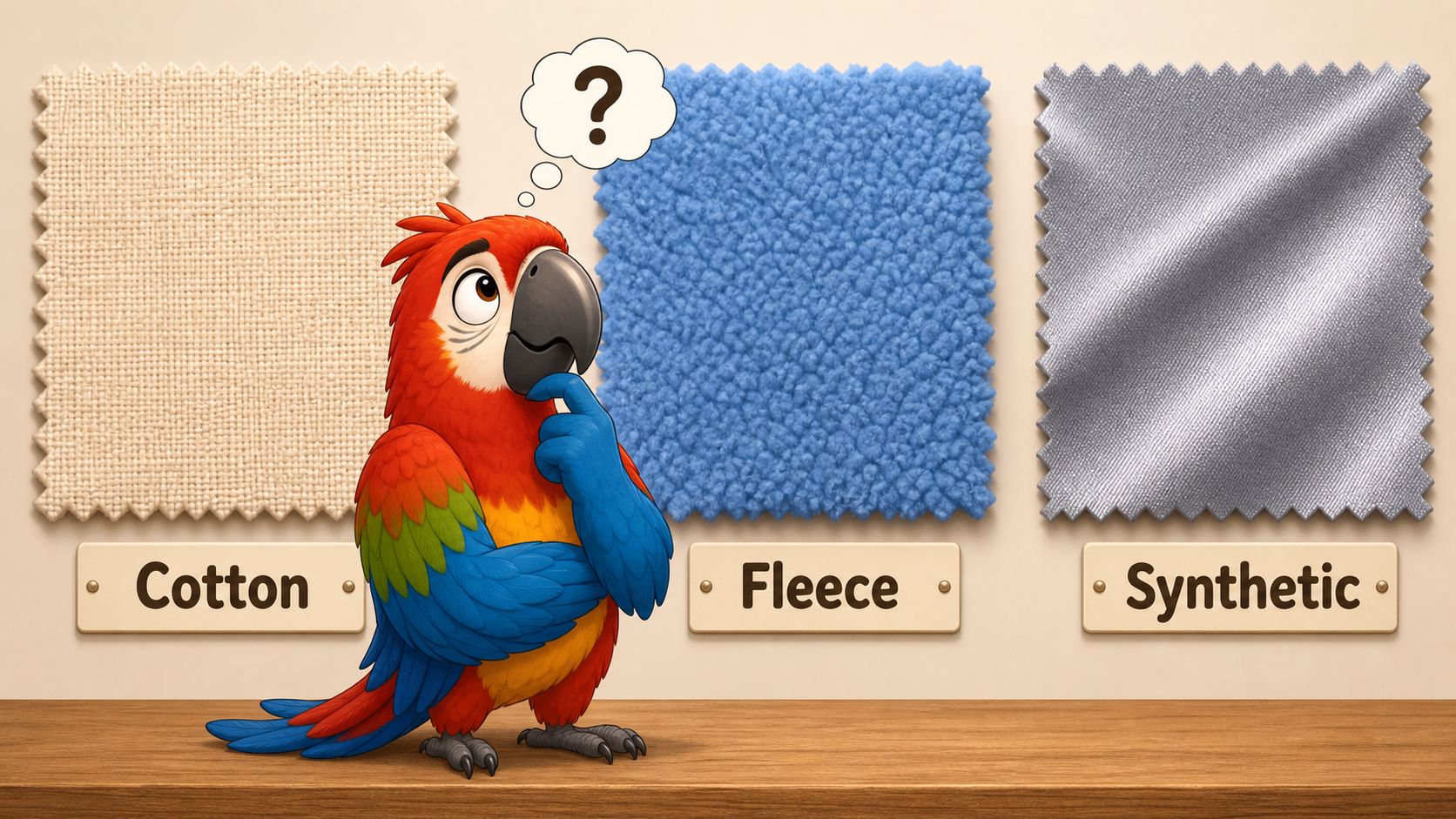
The best choices are usually breathable, washable fabrics with enough body to dim light and enough structure to hang away from the bars. In practice, that often means a medium-weight poly-cotton or tightly woven cotton blend. The A&E Cage Company cage cover listing is a useful example because it describes a machine-washable poly-cotton cover built for both light blocking and airflow. That balance matters more than chasing one perfect fabric formula.
What causes trouble is fairly predictable:
- Heavy fabric that holds heat
- Loose weaves that catch nails
- Thin material that frays after washing
- Fabrics with unknown coatings, scents, or finishes
- Anything soft enough and close enough to invite chewing
Household fabric can work, but only if it behaves like bird equipment, not bedding. A flat sheet may be breathable, yet many sheets slide, bunch, and leave tempting folds along the cage sides. Quilts and fleece throws block light well, but they are often too heavy for overnight use around parrots. I have seen owners keep adding thicker blankets because the bird still wakes early, when the solution lay in changing the room light and sleep routine instead of piling on fabric.
Purpose-made covers usually earn their keep through fit and predictability. They are cut for cage shapes, hang more cleanly, and are less likely to puddle where a bird can grab them. If you are comparing cover options for different setups, it helps to look at parrot cages in a range of sizes and shapes and picture where the fabric will fall in relation to your bird's sleeping perch.
Here's the practical trade-off:
| Material choice | Where it works well | Main concern |
|---|---|---|
| Poly-cotton blend | Good mix of darkness, airflow, and easy cleaning | Needs regular checks for wear |
| Light cotton sheet | Temporary or short-term use if fit is safe | Slips easily and may invite chewing |
| Heavy blanket or quilt | Rarely a good bird cover | Heat build-up and poor airflow |
| Decorative or textured fabric | Almost never worth the risk | Snags, frays, and attracts beaks |
Match the material to the bird in front of you. A quiet parrotlet that ignores fabric presents one set of risks. A cockatoo, macaw, or determined Amazon presents another. For strong chewers, the safest answer is often no fabric cover at all. Use blackout curtains, a darker sleep room, or a separate sleep cage instead of hoping the material will survive the night untouched.
This matters for hormonal birds too. If a dark, enclosed setup seems to increase nesty behavior, choose a lighter visual barrier or focus on darkening the room rather than wrapping the cage itself.
Choose material that supports sleep and stays boring. Boring is good at bedtime.
How to Fit and Use a Cage Cover Correctly
Fit matters more than many first-time owners expect. A cover that's too small pulls tight in the wrong places. A cover that's too large puddles, shifts, and gives a curious beak too much to grab.
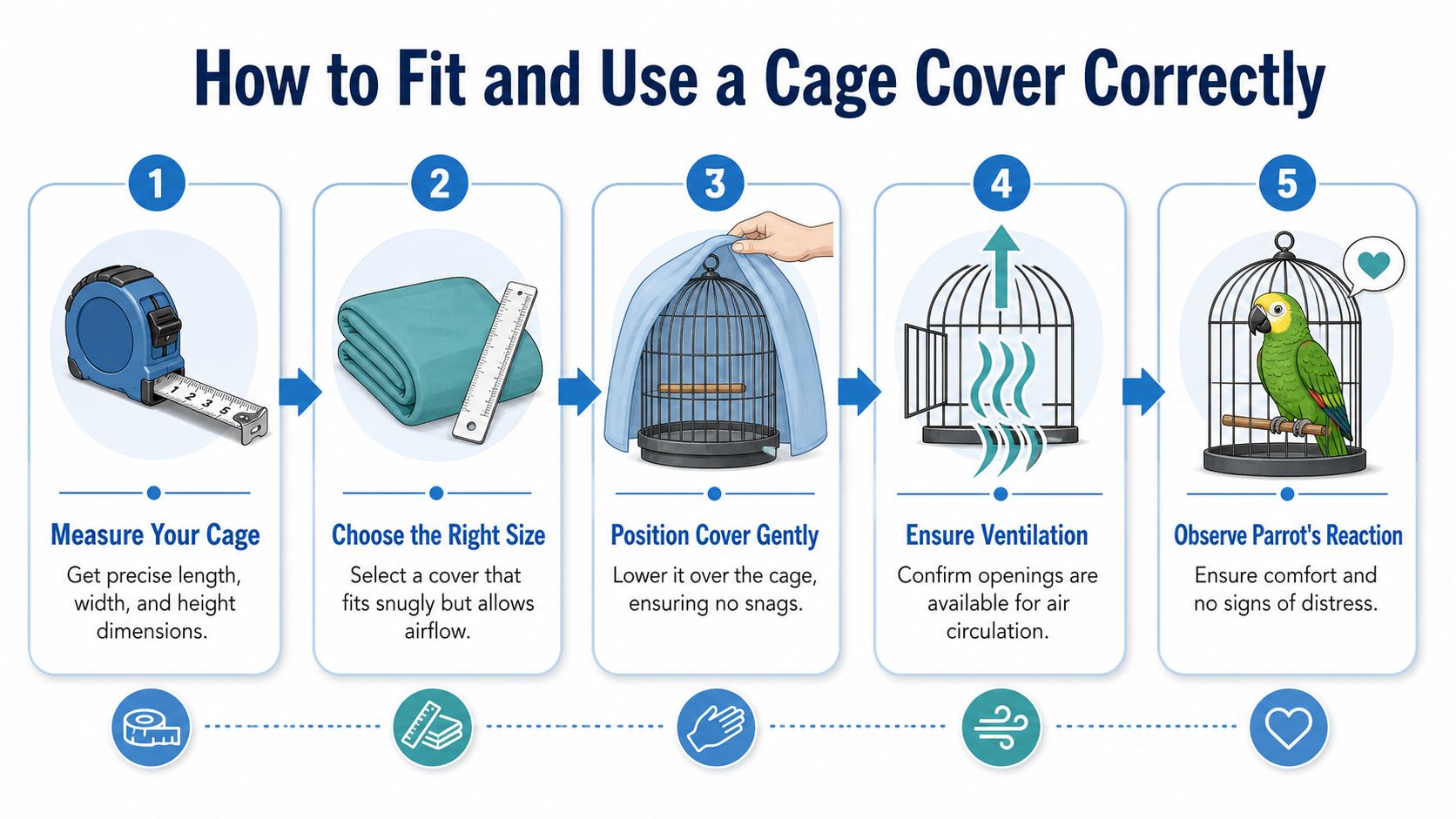
Start with the cage, not the product listing. Measure what your bird sleeps in, including unusual tops, trays, and any parts that change how fabric will hang.
Fit first, then routine
Commercial covers are often sold by cage shape and dimensions, especially for nonstandard cages like dome-top styles. That's a clue that fit and ventilation are real purchasing concerns, not tiny details. If you're comparing cage options too, browsing parrot cages by size and style can help you picture how a cover will sit.
Use this simple checklist:
- Measure width, depth, and height: Don't guess from memory.
- Notice shape changes: Dome-top and play-top cages need extra thought.
- Check access points: You don't want the cover snagging doors or feeder areas.
- Look at where the bird sleeps: If your parrot perches high and close to the side, they may be able to reach the fabric.
A visual guide can make the process easier:
Partial coverage is often the smarter move
RSPCA guidance cited by LaFeber recommends covering at least 2 sides of a cage to help birds feel more secure while preserving ventilation, especially when the cage is against a wall, as described in LaFeber's note on how many sides of a budgie cage to permanently cover.
That's one of the most useful rules of thumb for bird parents. You do not need to seal the whole cage like a package.
Cover the sightlines that bother the bird most. Leave enough openness for air and comfort.
How to make the routine feel normal
A good bedtime routine is quiet and boring in the best way.
Try this approach:
- Start before your bird is overtired: Bedtime should feel calm, not abrupt.
- Lower the cover gently: No sudden flapping fabric.
- Use the same order every night: Lights, quiet voice, cover, room settles.
- Watch the bird's response: Relaxed posture is your green light. Climbing, chewing, or alarm calls mean something needs changing.
That's how a parrot cage cover becomes part of care instead of just part of the cage.
Troubleshooting Common Cage Cover Problems
Most cage cover problems aren't really “cover problems.” They're information. Your bird is telling you something about fear, comfort, fit, airflow, or hormones.
The trick is to listen early. Don't wait until the cover is shredded, the bird is cranky, or bedtime turns into a nightly argument.
If your parrot chews the cover
Remove it. Don't keep testing the idea because the fabric looked expensive or matched the room.
A chewing bird may need a different sleep plan, especially if they're a cockatoo, macaw, or any determined fabric inspector. For many of these birds, room-darkening curtains, adjusted lighting, and a calm sleep area are safer than fabric on the cage.
Fit and ventilation are especially important for non-standard cages and large parrots like macaws, which need excellent airflow at night, as noted in the discussion around cage cover fit for dome-top cages.
If your bird is afraid of the cover
Go slower.
Set the cover near the cage during the day. Let your bird see it without pressure. Move it closer over time. Then start with very partial use instead of a full nighttime drape. New objects can be a big deal in parrot care, and forcing the issue usually backfires.
A fearful bird often does better with:
- Short exposure in daylight
- Gentle handling of the fabric
- A favorite perch or calm evening activity before bed
- Less coverage at first
If you're using a blanket from home
That can work badly for several reasons. Household blankets are often too heavy, too warm, or awkwardly sized. They may hang in ways that block airflow or create chewable folds and edges.
If you're between solutions, a better temporary option is often changing the room itself. Lower the lights earlier. Reduce TV glare. Move the cage away from traffic. Use blinds to darken the space. For some birds, that's the permanent answer.
If the cover seems to make behavior worse
Pay attention to timing and pattern. If the bird becomes more possessive, territorial, or edgy after regular cover use, the setup may be too enclosed. A cozy sleep space can become a nest-like one for some parrots.
That's when experienced owners usually simplify:
| Problem | Better next step |
|---|---|
| Bird chews cover | Stop using fabric on the cage |
| Bird panics under cover | Reintroduce slowly or skip it |
| Bird gets hormonal | Use less enclosed sleep setup |
| Cover doesn't fit cage shape | Find shape-specific option or use room-darkening instead |
A parrot cage cover is helpful only when it helps. If your bird sleeps better with partial coverage, great. If your bird rests better in a dark, quiet room with no cover at all, that's great too.
If you're building a safer sleep setup for your feathered friend, Squawk Shop has parrot care resources, cages, toys, and bird-focused gear that can help you create a calm routine without guesswork. Start with your bird's behavior, choose safety over tradition, and keep the goal simple. Happy birds make happy homes.