

Clicker Training for Birds A Fun How-To Guide
Your parrot is smart. You already know that.
Maybe a little too smart, if we're being honest. Smart enough to launch a sunflower seed to the floor when you offer the wrong one. Smart enough to stare at a new toy like it’s a personal insult. Smart enough to know exactly when you’re busy and that now is the perfect time to yell.
A lot of bird parents reach a point where they want more than shared space. They want communication. They want a better step-up, easier carrier trips, calmer handling, and a bird that sees training as a game instead of a battle.
That’s why clicker training for birds works so well. It gives you and your feathered friend a clear way to understand each other. It’s simple, kind, and surprisingly fun once it clicks. Pun intended. Your bird would approve, even if only dramatically.
What Is Clicker Training Anyway
Clicker training is a form of positive reinforcement. The click tells your bird, “Yes, that exact thing right there earned a reward.”
That’s the whole magic of it.
The click is not the reward itself. It’s a marker. Imagine a tiny camera shutter that captures the exact moment your bird does something you like. Then the treat follows right away.
Why birds learn so well with it
Parrots are always paying attention. They notice timing, patterns, and tiny changes in your body language. A clicker helps you be clearer than your hands or voice alone.
Instead of vaguely hoping your bird understands what “good job” means, you give a crisp signal at the exact right instant. That precision matters when you’re teaching things like touching a target stick, stepping onto your hand, or walking into a carrier without turning it into a feathery courtroom drama.
Here’s the part many people love most. Clicker training isn’t just for tricks.
It can help with:
- Handling skills like step-up and stationing on a perch
- Confidence building around new toys, playstands, and travel carriers
- Enrichment by turning learning into a daily problem-solving game
- Trust because the bird gets choice, clarity, and rewards
Practical rule: Training should feel like a conversation, not a contest.
A gentle method with real roots
This isn’t some internet fad cooked up last week between cute videos of parrots dancing.
The method grew from B.F. Skinner’s operant conditioning research in the 1960s, became popular with marine mammal trainers, and then took off in the pet world in the 1990s as a gentle and effective training system. The core idea is to “charge” the clicker by pairing the sound with a treat until the bird learns that the click means food is coming, as described by Clicker Training’s falconry and operant conditioning overview.
That science background matters, but you don’t need to be a behavior nerd to use it well.
What it feels like in real life
A bird that understands the clicker often starts leaning into training. You can almost see the gears turning.
They test things. They offer behaviors. They become active learners instead of passive passengers.
That change is one reason clicker work matters so much in animal welfare too. In the UK, birds made up 8.91% of all experimental animals used in 2022, totaling over 134,000 birds out of more than 1.5 million animals overall. A study on chickens showed rapid progress across early training days, and among 21 chickens, the most common character type was Type 1 at 42.9%, while Type 4 was rare at 4.8%, showing how individual birds respond differently and why careful, low-stress training matters, according to this published avian clicker training study.
If you’re also learning to read feathers, eyes, posture, and beak signals, pairing training with a good understanding of body language makes everything smoother.
Gathering Your Training Tools and Treats
You don’t need a fancy setup. You need the right setup.
Good clicker training starts before the first click. The more thoughtfully you prepare, the easier it is for your bird to succeed.
Pick a clear marker
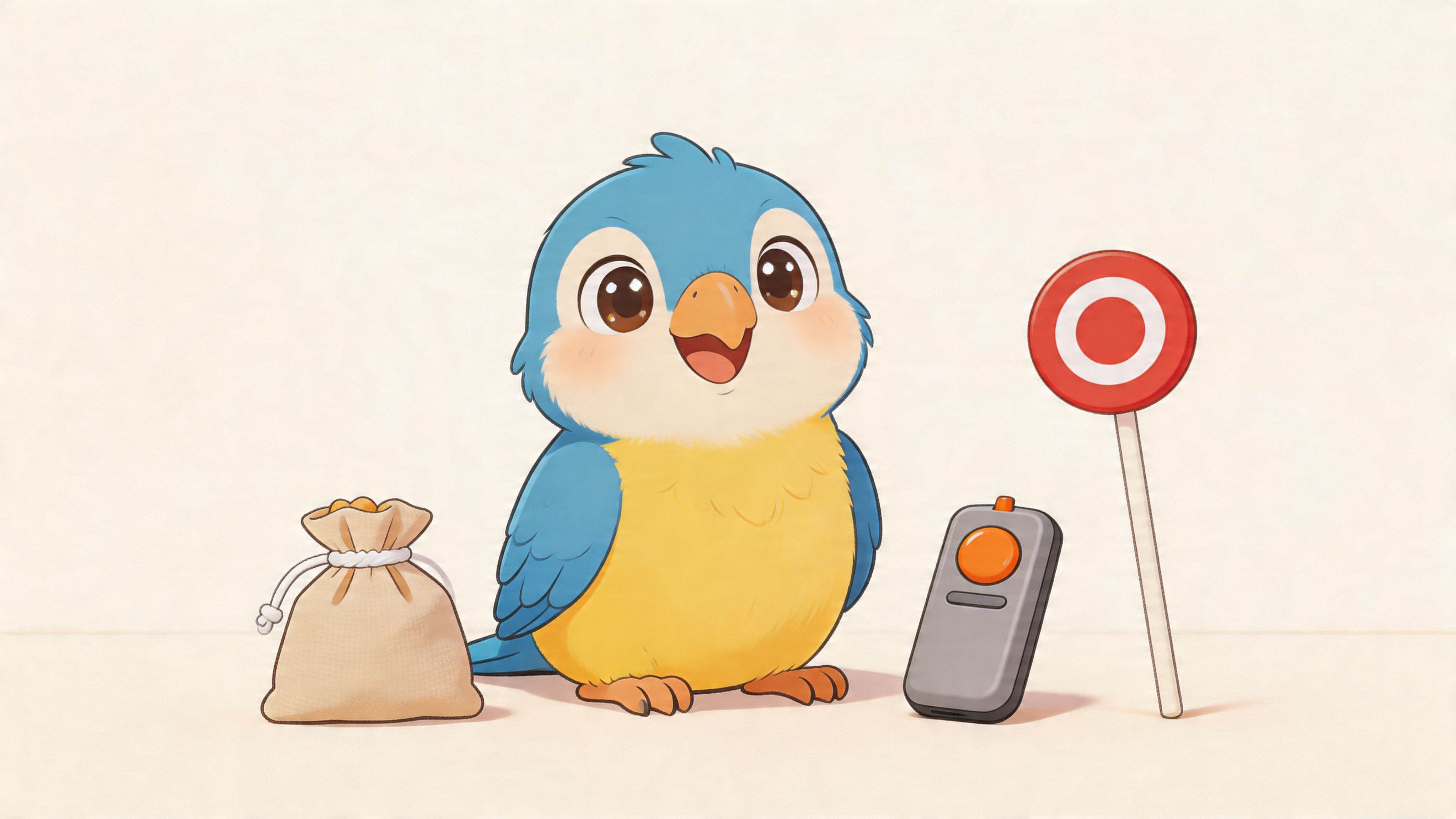
A handheld clicker is commonly used. A box-style clicker often gives a sharp, distinct sound that cuts through everyday room noise well.
That said, some birds think a loud clicker is suspicious and possibly evil. Fair enough.
If your bird startles at the sound, you can soften it by keeping the clicker in your pocket, wrapping part of it in a cloth, or choosing a quieter style. The right clicker is the one your bird can hear without fearing.
A simple target stick helps too. A chopstick, wooden dowel, or bird-safe target wand works well. For bigger parrots, sturdier options make life easier because a macaw can turn a flimsy stick into confetti in record time.
Choose treats your bird actually cares about
This part matters more than people think.
A “high-value” treat is not what you think should be exciting. It’s what your bird will work for. For some parrots that’s a tiny piece of almond. For others it’s safflower, sunflower, walnut, or a favorite little bit of fruit.
Keep these points in mind:
- Use tiny pieces so your bird doesn’t fill up too fast
- Save special treats for training so they keep their value
- Watch preference closely because one bird’s jackpot is another bird’s polite rejection
- Keep treats ready before you begin so timing stays clean
If you need a stash of training rewards, Squawk Shop’s bird treats collection is a useful place to compare options for different species and sizes.
Set the room up for focus
Your bird can’t learn well if the environment is chaotic.
A quiet perch, low distraction, and a calm few minutes work better than trying to train while the TV blares, dinner cooks, and another bird is hanging upside down nearby making opinions known.
A simple setup checklist helps:
| Tool | What to look for | Why it helps |
|---|---|---|
| Clicker | Clear sound, not too startling | Gives precise feedback |
| Treats | Tiny, high-value, easy to deliver | Keeps motivation high |
| Target stick | Bird-safe and easy to hold | Makes shaping simple |
| Perch or stand | Stable and comfortable | Helps the bird feel secure |
| Training space | Quiet and uncluttered | Reduces distraction |
Match the setup to the bird
Budgies and cockatiels often do well with very small treats and very short sessions.
Conures usually bring plenty of enthusiasm, plus a little chaos. African Greys may pause and study everything first. Amazons can be bold and opinionated. Cockatoos often want the social part as much as the food. Macaws may need more durable equipment and a bit more working space.
A good training setup feels calm, clear, and easy for the bird to win in.
If your parrot is new to your home, don’t rush. Let them settle. Training works best when your bird feels safe, curious, and willing to engage.
Mastering the Click and First Behaviors
The first session should feel almost boring to you. That’s a good sign.
If you keep it simple, your bird gets to learn the game without stress. The goal is not to impress anyone. The goal is to build a clear bridge between the click and the reward.
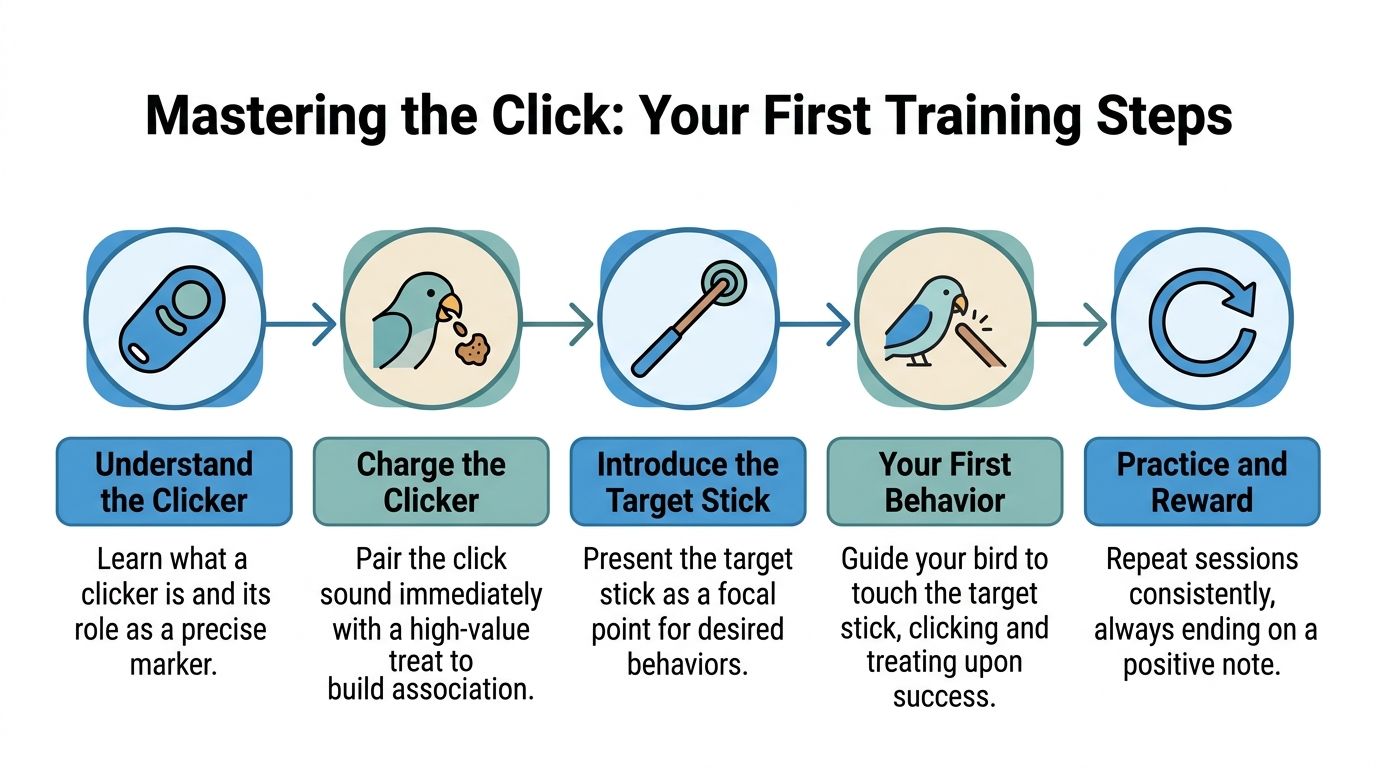
Charge the clicker first
Before you ask for any behavior, teach your bird what the click means.
The basic routine is simple. Click, then treat. No cue. No trick. No demand. Just a clean pairing over and over.
According to BirdSupplies’ clicker training guide for birds, you should click and immediately deliver the treat 20 to 50 times per 2 to 5 minute session. Success looks like your bird perking up and looking for the reward when they hear the sound.
That’s the moment the light bulb starts to turn on.
What charging looks like in real life
A first session often goes like this:
-
Place your bird somewhere comfortable
A favorite perch, cage top, or playstand works well. -
Click once
Don’t wave the treat first. Let the sound come first. -
Deliver the treat immediately
Fast timing matters more than elegance here. -
Pause briefly
Give your bird a second to swallow and reset. -
Repeat
Keep the rhythm calm and predictable.
Some birds catch on quickly. Others need a little more repetition. Both are normal.
If the click happens and your bird’s eyes brighten or they look toward your hand, you’re on the right track.
Start target training
Once the click has meaning, target training is usually the best first behavior.
Why targeting? Because it gives your bird a simple, physical action to succeed at. It also becomes the base for lots of useful skills later, like step-up, moving between perches, entering a carrier, and recall.
Hold the target stick a short distance away. Don’t poke. Don’t chase. Just present it.
Then reward tiny steps toward success.
Shape the behavior in layers
At this point, many bird parents accidentally ask for too much too soon.
Your bird does not need to boop the stick on the first try. Start with smaller wins. Training works best when you reinforce approximations.
A typical shaping path looks like this:
- Reward a glance at the target stick
- Then reward a lean toward it
- Next, click for a step toward it
- Finally, click for a touch with the beak
When your bird is doing one level well, you raise the criteria a little. The same source notes that when teaching a new behavior like targeting, you should aim for an 80% to 90% success rate on one step before moving on.
That keeps your bird confident instead of confused.
Timing is the real skill
The click must happen during the behavior you want.
Not after your bird turns away. Not while they’re already thinking about the next thing. Not while you’re fumbling for a seed cup and wondering where your life went off script.
A delayed click can mark the wrong behavior and slow learning. The same guide says poor timing can slow acquisition by 50% to 70%.
That sounds dramatic because it is. Timing can make a simple lesson feel easy or weird.
A few things that work well
Keep your hands quiet
Many parrots focus hard on hands because hands often carry treats. If your fingers wiggle too much, your bird may target the hand instead of the stick.
End before your bird gets bored
A tiny win is enough. A clean finish beats dragging the session until your bird wanders off to chew the stand.
Raise criteria slowly
If your bird looked at the stick three times, don’t suddenly demand a touch from across the room. Build in tiny steps.
Small steps teach faster than big leaps.
What doesn’t work well
Some common mistakes show up fast:
- Repeating cues too early because the bird hasn’t learned the action yet
- Showing the treat first which can turn the reward into a lure every time
- Pushing the target at the bird instead of letting the bird choose to move
- Training too long until everyone gets cranky
- Clicking late and rewarding the wrong moment
If your bird seems puzzled, that’s information, not failure. Lower the difficulty. Make the next rep easier to win.
Level Up Your Training with Fun and Useful Skills
Once your bird understands targeting, training opens up in a lovely way. You stop asking, “Can my bird learn this?” and start asking, “How can I make this useful and fun?”
That shift matters. The best bird training isn’t a circus act. It’s daily life made smoother, safer, and more enriching.
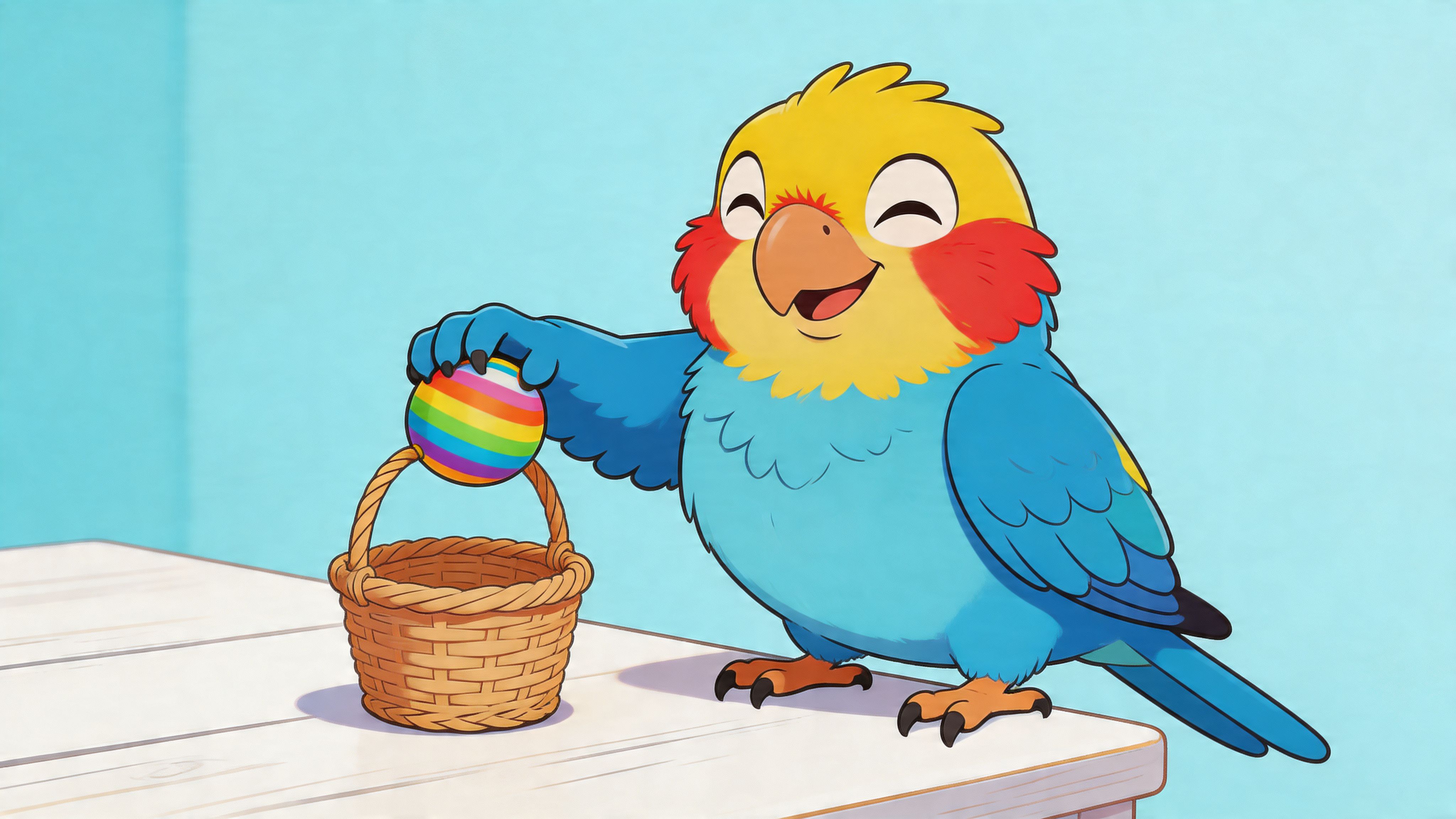
Teach step-up without a tug-of-war
A lot of parrots hear “step up” and think, “Counteroffer. I lean away and we both get emotional.”
Targeting can help remove that tension.
Instead of bringing your hand straight at the bird and hoping for cooperation, place your hand where the bird can step comfortably, then use the target stick to guide one small movement toward it. The moment a foot shifts onto your hand, click and reward.
Then build from there.
For cautious birds, reward:
- leaning toward the hand
- lifting one foot
- placing one foot on the hand
- transferring both feet
This approach feels less pushy. Your bird is moving toward a target, not being cornered by a giant hand with plans.
Build recall in a safe, gradual way
Recall means your bird comes to you on cue. That can be a short walk across a perch or a full flight between stands in a safe space.
For many bird parents, recall becomes the most satisfying skill they teach. It’s practical, bonding, and mentally rich.
Start small. A short hop or step counts. Present the target near your hand or perch, click when your bird comes over, then reward.
Later, you can increase distance. You can also teach recall between stable perches or playstands so your bird learns to move with confidence through the room.
A lot of parrots enjoy this because it turns movement into a game with clear rules.
Use training to introduce toys and foraging
One of my favorite uses for clicker training for birds is helping them approach new enrichment.
Some parrots love a new toy instantly. Others look at it like it just filed taxes in their name. Clicker work helps cautious birds explore instead of avoid.
Try this with a new foraging toy:
- Place the toy nearby, but not too close.
- Click and reward calm looking.
- Reward a step toward it.
- Reward touching it.
- Reward interacting with it, like nudging, turning, or pulling a part.
That process teaches more than toy use. It teaches confidence.
If you rotate enrichment and want ideas for shredding, chewing, and puzzle play, Squawk Shop’s bird toys collection can help bird parents compare options by size and play style.
Carrier training counts as a life skill
A carrier shouldn’t only appear on stressful days.
Training gives you a kinder way to build positive associations long before a trip or appointment. Set the carrier out in the room, reward calm interest, then target your bird toward it a step at a time. Later, reward stepping onto the door, leaning in, and eventually walking inside.
That turns the carrier from “ominous box of betrayal” into “place where snacks happen.”
Here’s a helpful visual example of bird training in action:
Keep useful skills tied to daily enrichment
Training goes farther when it connects to the actual world your bird lives in.
A target can guide your parrot:
- onto a perch for nail checks
- across a playstand for exercise
- into a carrier for travel practice
- toward a foraging toy to build curiosity
- away from a spot you don’t want them chewing
That’s why I like to think of clicker training as enrichment with direction. Your bird gets mental work, physical activity, and a better way to succeed in the home.
Keeping Sessions Short Sweet and Successful
Most training problems are not really training problems. They’re setup problems.
The bird is tired. The treat is boring. The room is too loud. The step is too big. The session went on too long. Any one of those can make a smart bird look “stubborn” when they’re just saying, very reasonably, “This plan needs work.”
What a good session feels like
A strong session is short, clear, and upbeat.
You want your bird finishing with interest still in the tank. That creates eagerness for the next round instead of relief that it’s over.
A solid rhythm usually includes:
- A quick start with an easy win your bird already understands
- A few repetitions at the current level
- Tiny breaks so your bird can reset
- A simple finish on a successful rep
If your bird starts preening, wandering, fluffing off-task, or getting grabby, listen to that feedback.
Stop while the bird still wants more. That’s how you build momentum.
Common issues and the fix
The clicker scares my bird
Muffle it. Put it in your pocket, behind your back, or inside a soft cloth. Some birds do better if you begin with a quieter marker until they relax.
My bird doesn’t care about the treat
The reward isn’t valuable enough in that moment. Try a different treat, train before a meal, or use a favorite food your bird doesn’t get all day long.
My bird gets frustrated fast
You probably jumped criteria. Go back to an easier version and reward sooner.
My bird loses focus with other birds around
That’s common in multi-bird homes. Distance helps. Visual barriers help too. Sometimes the easiest answer is rotating birds for solo sessions.
Noisy rooms need a different marker sometimes
Not every home gives you a peaceful little training studio.
If you train in a busy household, around multiple birds, or during travel prep, a clicker may get lost in the sound. In those cases, trainers can use a verbal bridge like “Good!” or “Yes!”. Some studies on captive birds showed a consistent verbal marker can outperform a clicker in loud settings by up to 40% in response rates, which is especially useful for carrier and travel training, according to Liberty Wings’ clicker training article.
That doesn’t mean the clicker is bad. It means the environment matters.
A simple troubleshooting table
| Problem | Likely cause | Better approach |
|---|---|---|
| Bird turns away | Criteria too hard | Reward a smaller step |
| Bird lunges at hands | Treat delivery is messy | Keep movements smooth and predictable |
| Bird screams during session | Overarousal or frustration | End early and lower intensity next time |
| Bird only works when seeing treats | You’re luring too much | Hide treats until after the click |
| Bird ignores the marker | Weak association | Refresh the marker with easy pairings |
Consistency beats intensity. Birds learn from clean repetition, not marathon sessions.
The travel carrier exception
Carrier practice deserves its own patience.
Training for travel often means dealing with odd sounds, movement, and new surroundings. In that case, a verbal marker may stay clearer than a mechanical click. Keep the sessions calm, reward interest in the carrier, and don’t wait until the day you need to leave.
If your bird only sees the carrier before stressful events, they’ll remember that. Birds are not forgetting professionals.
Training Tips for Medium and Large Parrots
Your macaw targets beautifully for three reps, then decides the stick is now a chew toy and your fingers look like part of the package. That moment is where generic bird training advice falls apart.
Medium and large parrots learn fast, notice everything, and have the beak strength to expose sloppy setups right away. The clicker still works. The difference is how carefully you set the lesson up and how well it fits real life with a bigger bird.
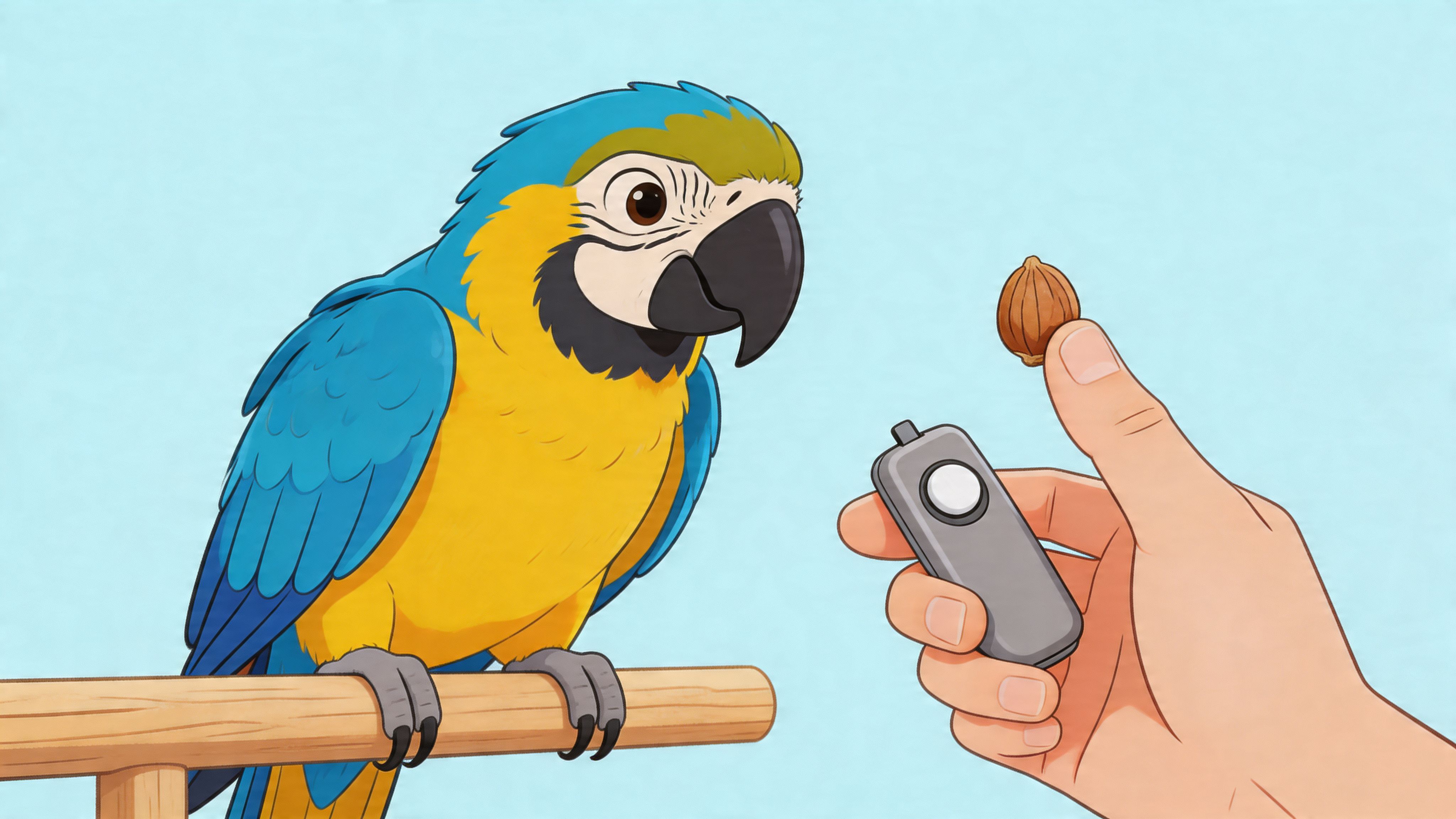
Use equipment that fits the bird
A target stick that works fine for a budgie may last about twelve seconds with a cockatoo. Training tools for larger parrots need to protect your hands, stay predictable, and hold up to real use.
Set yourself up with:
- A sturdy target stick that will not snap or fray quickly
- A hand position off to the side of the beak, not in front of it
- Small, high-value treats that matter to the bird but do not slow the pace
- A steady training station or playstand so the bird is not wobbling while trying to learn
For birds in that in-between size range, this collection for medium birds can help you find toys and setup ideas that match their scale better than one-size-fits-all gear.
Good equipment lowers friction. It also keeps training from turning into a contest of beak versus plastic.
Give them harder jobs, not messier sessions
Many medium and large parrots can stay engaged longer than smaller birds. That does not mean they need longer lectures. It means they often enjoy more interesting assignments.
Ask for a clean target touch from two positions instead of ten rushed reps in one spot. Teach a Grey to walk from perch to scale. Teach an Amazon to station calmly on a playstand while you change a toy. Ask a macaw to touch, turn, and return to perch as one short sequence.
That kind of training does two things at once. It builds skill, and it gives the bird useful mental work.
Use enrichment as part of the lesson
Clicker training shines when it connects to the bird’s daily routine. Medium and large parrots often need more than a few standalone tricks to stay satisfied, and training can bridge that gap.
Use the clicker to introduce:
- stepping onto a specific perch on a playstand
- touching or opening parts of a foraging toy
- moving calmly between two stations
- placing feet on a scale
- entering a carrier or travel perch without drama
- shifting away from a favorite spot on cue
That turns training into enrichment instead of a separate chore. The bird learns how to interact with the home in safe, successful ways, and trust grows because your cues start to predict clarity and reward instead of pressure.
Reinforcement changes as the bird understands the game
New behaviors still need frequent pay. Once the behavior is clear and relaxed, many larger parrots do well when food rewards become a little less predictable.
That does not mean getting stingy.
It means keeping the bird interested with a thoughtful mix of rewards. A known behavior might earn a small treat one rep, praise and a quick head bob from you the next, then a better treat or jackpot after a particularly nice effort. Used well, that keeps motivation up without creating a bird who only wants to work if it sees a snack in your fingers.
Here is a practical way to look at it:
| Training stage | Smaller or newer learner | Medium or large parrot with a known behavior |
|---|---|---|
| Learning a new skill | Reward every correct rep | Reward every correct rep |
| Early fluency | Keep rewards frequent | Keep rewards frequent |
| Strong fluency | Mix in praise and occasional jackpots | Vary food rewards thoughtfully to hold interest |
| Session structure | Very short and simple | Slightly longer if the bird stays calm and engaged |
Watch arousal, not just accuracy
A big parrot can be technically correct and still be heading in the wrong emotional direction. I pay close attention to how the bird is taking the treat, how hard it is staring, and whether the body is getting tighter with each rep.
Common warning signs include:
- eye pinning with stiff posture
- lunging forward before the cue
- snatching treats roughly
- grabbing the target instead of touching it
- louder, sharper vocalizing that builds with frustration
At that point, lower the difficulty right away. Slow your hands. Ask for an easy win. End before the bird feels the need to make a bigger statement.
Clean training matters more than bold training with these species.
Build trust through useful routines
Medium and large parrots are often the birds people describe as stubborn, intense, or dramatic. Sometimes that is personality. Sometimes it is a bird reacting to unclear handling and not enough meaningful work.
Clicker training helps because it gives the bird a clear way to succeed. The marker says, “Yes, that exact choice worked.” Over time, that clarity carries into everyday care. A bird that has practiced targeting to a perch usually handles movement better. A bird that has learned to interact with foraging toys through training often approaches new enrichment with less suspicion. A bird that stations calmly on a playstand is easier to live with and usually feels safer too.
This is the primary value here. You are not just teaching tricks for applause from the flock in your living room. You are giving a smart, powerful bird a fair system, a job to do, and more reasons to trust you.