

A Guide to Safe and Affordable Bird Cages for Parrots
You're probably doing what most bird parents do at first. You open a dozen tabs, compare cage photos, stare at measurements, and wonder why one cage costs so much more than another when they look almost the same.
That's a normal place to start.
The tricky part is that affordable bird cages aren't really about finding the lowest sticker price. They're about finding a cage that keeps your parrot safe, fits your home, works for daily cleaning, and doesn't turn into a replacement project a year later. A cage can look like a deal and still cost you more in stress, maintenance, and upgrades.
A good cage should support climbing, stretching, chewing, and all the little daily habits that make parrots feel secure. Happy birds make happy homes. The cage is a big part of that.
Welcome to Your Bird Cage Buying Guide
Shoppers for a first parrot cage want the same thing. They want something practical, not over-the-top, and they want to spend carefully. That makes sense. Between perches, bowls, foraging toys, bird-safe toys, and everyday care items, the setup adds up fast.
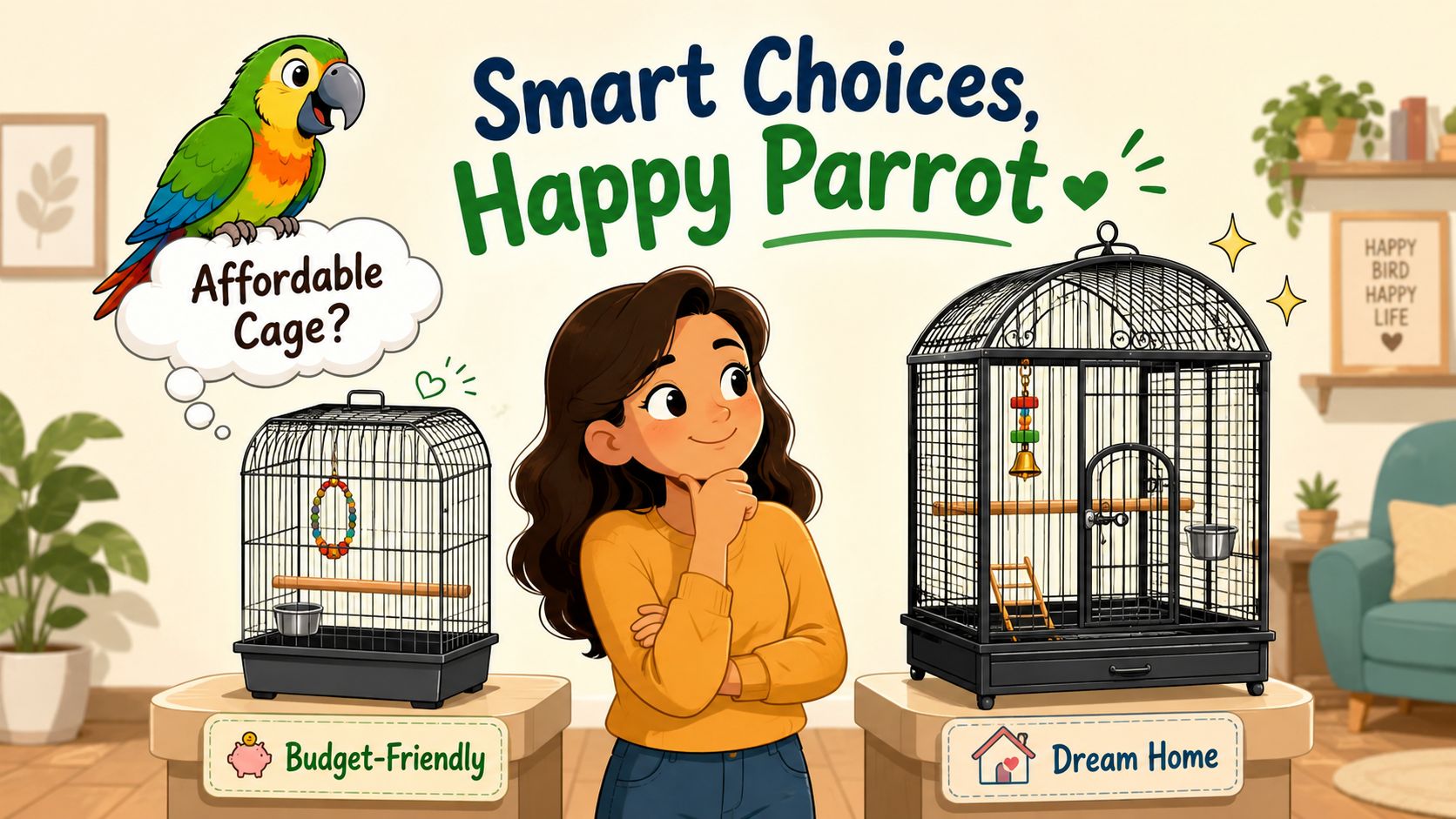
The good news is that you're not shopping in some tiny niche with no options. The global bird cages market was valued at USD 2.7 billion in 2023 and is growing, which tells us bird parents looking for practical value are shopping in a large, active market with plenty of choices (Cognitive Market Research bird cages market report).
What affordable should mean
For parrots, “affordable” should mean three things:
- Safe first: The cage uses bird-safe materials and solid construction.
- Sized appropriately: Your bird can move, climb, and stretch without feeling cramped.
- Built to last: You're not replacing it because of rust, bent bars, bad latches, or peeling coating.
That's the whole game.
Practical rule: The cage that costs less to own over time is often the cage that looked slightly more expensive on day one.
What works and what doesn't
What works is a simple, sturdy cage with the right bar spacing, good access doors, and an easy-clean tray. Fancy curves and decorative tops matter a lot less than reliable construction.
What doesn't work is buying based on looks alone. I've seen plenty of cages that photograph nicely and still miss the basics. Awkward feeder doors, flimsy bars, rough welds, and coatings that don't inspire confidence are not small details. They affect your bird every single day.
If you're feeling unsure, that's okay. You don't need to know everything right now. You just need a clear filter for separating a good-value cage from a frustrating one.
Thinking Beyond the Price Tag
A bird cage is a little like shoes. The cheapest pair can get you out the door, but if they fall apart, hurt your feet, and need replacing fast, they weren't the better value.
Parrot cages work the same way.
The total cost of ownership mindset
When bird parents shop for affordable bird cages, many focus on the checkout price. That's understandable, but parrots live with that cage every day. You clean it, open it, move around it, attach parrot toys to it, and trust it to keep your feathered friend secure.
A cage that seems like a bargain can become expensive if it:
- Starts rusting: Especially around trays, welds, or hidden corners
- Uses a weak finish: Chipped coating creates a maintenance problem and a safety concern
- Has poor access: Tiny doors make cleaning and handling harder than it needs to be
- Needs replacing early: That “great deal” loses its shine fast when you're shopping again
Why long-term value matters
A good-value cage usually makes life easier in small, daily ways. The tray slides out smoothly. The grate sits properly. The front door is large enough for safe access. Food bowls don't feel like a wrestling match. Those details save time and reduce frustration.
That matters for your bird too. A cage isn't just storage. It's part bedroom, part gym, part snack station, part climbing wall. A well-designed cage supports enrichment and routine. A poorly designed one creates stress for both of you.
The right cage should feel boring in the best possible way. It works, stays solid, cleans easily, and never gives you a reason to worry.
Value is not the same as luxury
You do not need the fanciest cage on the market to make a smart choice.
Sometimes the better buy is a plain rectangular cage with strong materials and good doors. Sometimes it's a used cage in excellent condition from a trusted source. Sometimes it's a mid-tier powder-coated cage that meets safety standards and fits your bird properly, while you spend the rest of your setup money on perches, foraging, and bird-safe toys.
What you're looking for is not perfection. You're looking for the best combination of safety, size, durability, and daily usability your budget can support.
That's what makes a cage feel affordable in real life.
Non-Negotiable Safety Features for Any Cage
This is the part where being picky helps your bird.
A cage can be plain, pre-owned, or modestly priced and still be a strong choice. But some things should never be negotiable. If a cage misses the safety basics, keep scrolling.
Bar spacing comes first
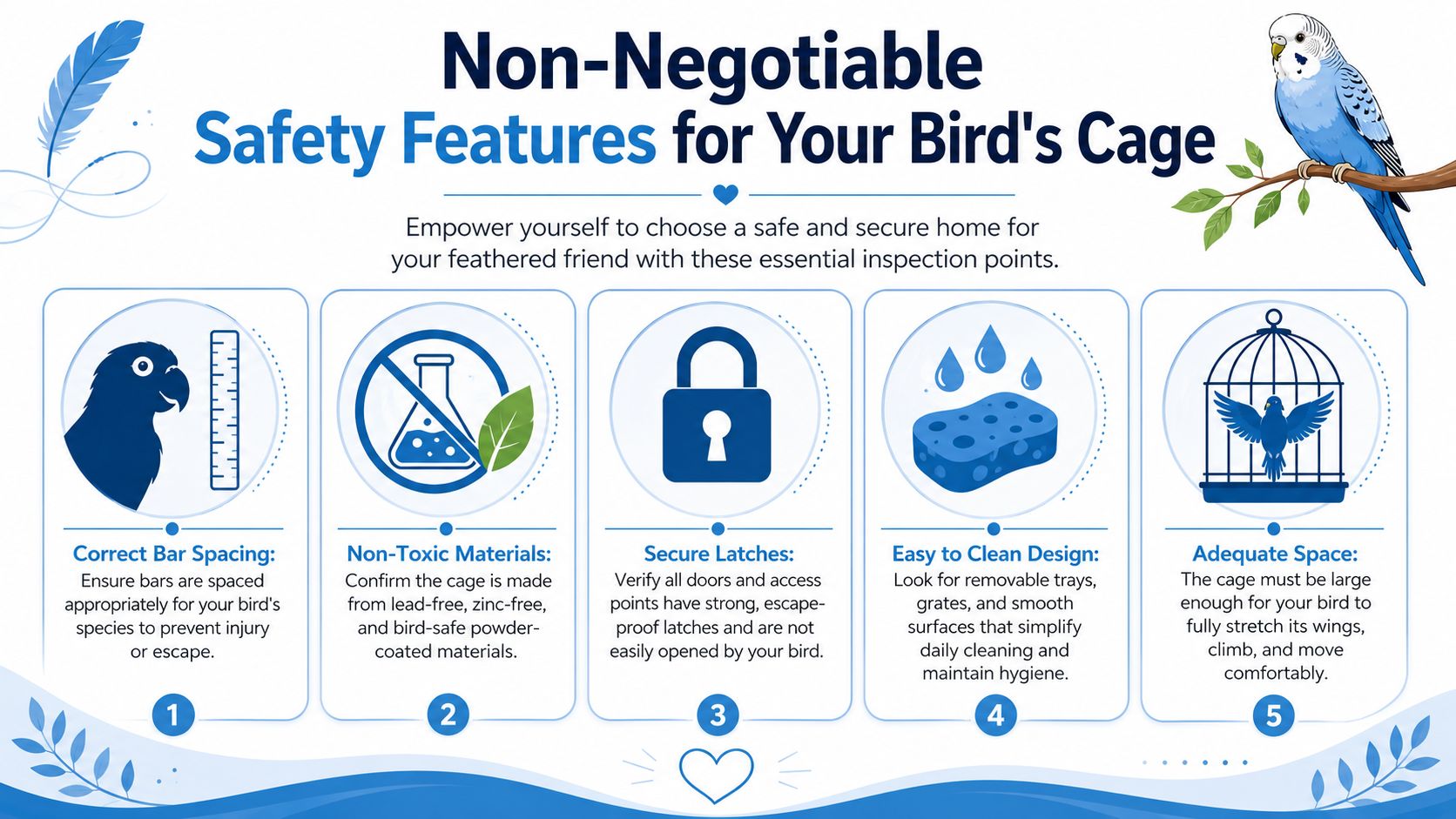
Bar spacing is one of the biggest safety checks. General guidance puts 1/2 inch spacing around small birds like budgies, 5/8 inch around cockatiels, and 3/4 to 1 inch for larger parrots like African Greys, so heads or limbs don't get trapped (BirdTricks guide to selecting the right cage).
If the spacing is too wide, a bird can get stuck. If it's wrong for the species, a cage that looked roomy can become risky.
For a closer look at how spacing and strength work together, Squawk Shop has a helpful guide on bird cage bars and what to look for.
Strength matters just as much as spacing
Spacing gets most of the attention, but bar gauge and weld quality matter too. If you can squeeze bars together by hand, that cage is not sturdy enough. Birds can wedge a head, foot, or wing into weak gaps.
Look closely at:
- Welds: They should look smooth and solid, not rough or sloppy.
- Bar rigidity: Bars should not flex easily.
- Corners and joints: These are common weak spots.
- Door frames: A strong cage often shows its quality here.
A cage can have the right dimensions on paper and still fail the hands-on test.
Here's a useful video if you want a visual feel for what solid cage features look like while shopping.
Safe materials are not optional
Practical guidance for parrot cages consistently points toward stainless steel, ceramic powder coating, and acrylic as safe material choices, while also stressing that birds need a separate safe play area for enrichment, not just time inside the cage (Pearl Parrots guidance on cage size and safe materials).
If you're comparing finishes, inspect the surface carefully. You want a coating that looks intact and well-applied, not thin, chalky, or flaky. If a cage has chipped areas, mystery wear, or obvious corrosion, move on.
Doors, trays, and everyday safety details
Small design choices can make a big difference.
| Feature | What to look for | Why it matters |
|---|---|---|
| Main door | Large, smooth, easy to secure | Safer handling and easier setup |
| Latch | Firm and not easy for a clever beak to open | Prevents escape |
| Tray | Removable and stable | Makes cleaning easier |
| Grate | Properly seated with no sharp spots | Reduces injury risk |
| Access bowls | Easy to refill without awkward reaching | Less daily stress |
Some parrots are tiny engineers in feather pajamas. If a latch looks simple to you, assume your bird may find it entertaining.
Where to Save Money and Where to Splurge
A smarter cage purchase usually comes down to one question. Which features lower the chance that you'll need to replace this cage, fight with it daily, or worry about safety later?
That's the actual total cost of ownership.
Where it makes sense to save
Some compromises are reasonable, especially for new bird parents building a full setup.
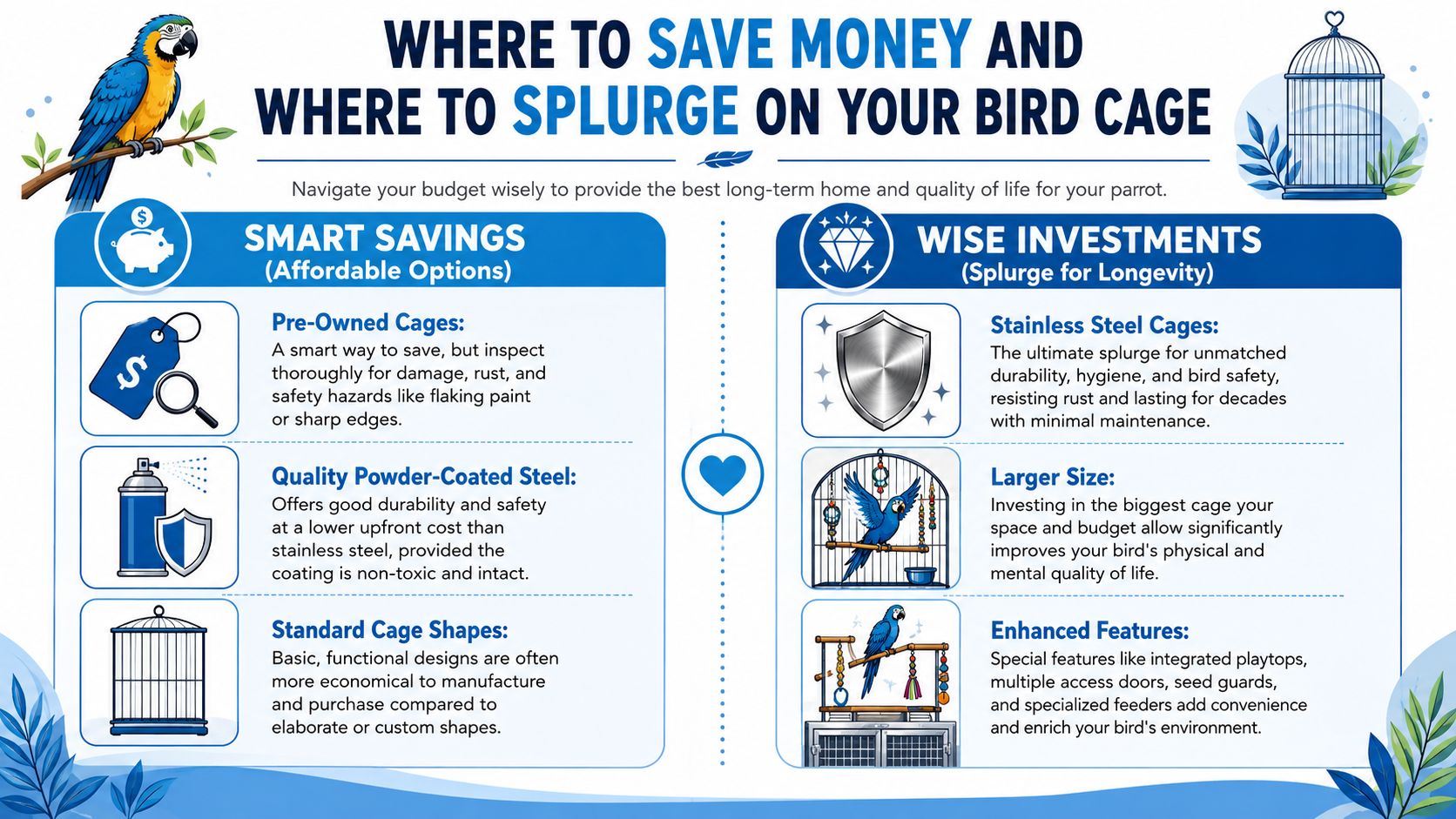
- Simpler cage shapes: Straightforward rectangular cages are often easier to clean and usually more practical than decorative shapes.
- Powder-coated steel in good condition: This can be a solid option if the finish is bird-safe and intact.
- Pre-owned cages: A used cage can be excellent value if it passes a careful inspection for rust, wear, weak bars, and damaged coating.
You can also save by skipping flashy add-ons you may not need right away. A playtop is nice. A safe cage body is more important.
Where spending more pays off
One major long-term trade-off is material. Guidance on parrot cages notes that while stainless steel costs more upfront, it's designed to last a bird's lifetime and resists rust and chewing, while a lower-cost cage that fails from corrosion or beak damage can bring replacement costs and safety risks (Quill and Roost guide to finding the perfect bird cage).
That matters most for strong-beaked parrots like African Greys, Amazons, cockatoos, and macaws. These birds test hardware. They inspect corners. They pry, chew, and lean into weak spots like it's a part-time job.
Spend more on the parts your bird interacts with every day. Material quality, bar strength, and door construction matter more than decorative extras.
A practical trade-off table
| If money is tight | Better move | Poor move |
|---|---|---|
| You can't afford the biggest cage in the style you want | Choose a simpler cage with stronger materials | Choose a prettier cage with weaker construction |
| You're comparing finishes | Pick intact, bird-safe powder coating | Accept chipped or suspicious coating |
| You want to buy once | Consider stainless steel for a heavy chewer | Buy the lightest cage available and hope it holds up |
If you're actively comparing options, Squawk Shop's parrot cage collection is one place to review cage styles and sizes for species from cockatiels to African Greys and Amazons.
The hidden costs people forget
The biggest hidden costs are usually not dramatic. They're annoying.
A tray that sticks. A latch that catches. Bars that are hard to clean. Food doors that spill every time you open them. A finish you have to inspect constantly. These things wear on you, and they affect consistency with cleaning and cage setup.
A cage doesn't need to be fancy. It needs to be dependable.
Matching the Right Cage to Your Parrot
The “right” cage changes a lot depending on who's living in it. A cockatiel's needs are different from an African Grey's. A conure may use space differently from a macaw. Size, bar spacing, climbing style, and beak strength all matter.
Guidance for companion birds says a cage should be at least 1.5 times your bird's wingspan, and for species like African Greys or small cockatoos, that often means a minimum footprint around 36 inches by 30 inches (Lafeber on your bird's home).
Small parrots like budgies and parrotlets
For little birds, people often underestimate width.
A small parrot still needs room to move side to side, hop, climb, and flap safely. In practice, that usually means looking for a wider flight-style cage instead of a tall, narrow one. With smaller species, bar spacing needs special attention because escape and entrapment risks show up fast when gaps are too large.
A good setup for these birds usually includes:
- More horizontal room: Great for movement and climbing
- Multiple natural perches: Different textures help feet
- Lighter enrichment: Swings, shredders, and easy foraging options
Cockatiels and conures
This is the range where many first-time bird parents shop, and where cage mistakes are common because the options look similar online.
Cockatiels need enough room for tail clearance, wing stretching, and climbing. Conures are often more athletic and curious, so access doors and interior layout matter a lot. For both, I'd lean toward a sturdy rectangular cage with easy front access over a decorative shape that wastes usable space.
Look for a cage that lets you place:
- a main perch near the upper third of the cage
- food and water without crowding the center
- a few rotating parrot toys
- one or two simple foraging stations
African Greys and Amazons
The term “affordable” grows more complicated.
Medium-to-large parrots need more than a cage that technically fits in the room. They need sturdiness, enough usable interior space, and hardware that can stand up to a smart bird with a strong beak. If you have to choose between extra decoration and better construction, choose construction every time.
For many bird parents, this is also the point where a used high-quality cage can make more sense than a flimsy new one. The inspection matters, but the logic is sound.
Cockatoos and macaws
Large parrots punish weak cages.
With these birds, a lower upfront price can become expensive quickly if bars flex, welds fail, or coating wears badly under heavy chewing. Door security matters a lot too. Some larger parrots can treat a basic latch like a puzzle toy.
Bigger parrots don't just need more space. They need more cage.
For large species, prioritize strength, access, and durable materials before you think about extras. A simple, solid enclosure beats a feature-heavy cage that can't handle the bird inside it.
Your Smart Shopper Checklist for New and Used Cages
When you're standing in front of a cage, it helps to have a simple routine. Not a vague feeling. Not “this one seems nice.” A real checklist.
One hands-on rule matters for every cage, new or used. Make sure the bars cannot be squeezed together by hand. Weak bars or welds can create dangerous gaps where a bird may trap its head, feet, or wings. That's a major red flag.
Start with the hands-on test
Before you admire color or shape, test the structure.
-
Grip the bars firmly
Try to squeeze or flex them. They should feel solid. -
Check the welds and joints
Look around corners, feeder doors, and main door frames. -
Run your hand carefully along edges
You're checking for rough spots, sharp edges, or sloppy finishing. -
Open and close every door
If a latch feels flimsy in the store or at pickup, it won't improve later.
What to inspect on a new cage
A new cage should still earn your trust.
- Finish quality: Look for an even surface with no chips or thin spots.
- Tray function: Slide it out and back in. A stuck tray becomes an everyday annoyance.
- Grate fit: Make sure it sits properly and doesn't wobble.
- Bowl access: Refill points should feel practical, not awkward.
A lot of bird parents focus on dimensions and forget usability. If daily care is frustrating, the cage won't feel like a good purchase for long.
Red flags on used cages
Used cages can be a smart buy. They can also be a headache in disguise.
| Check area | Good sign | Walk-away sign |
|---|---|---|
| Bars | Straight and rigid | Bent, bowed, or easy to flex |
| Finish | Intact and smooth | Flaking, bubbling, or mystery patches |
| Rust | None visible | Rust at joints, tray rails, or hidden corners |
| Doors | Close cleanly | Misaligned or loose |
| Interior | Clean and well-kept | Heavy wear, grime, or unknown residue |
Ask practical questions too. Was it used for a parrot with a strong beak? Was it stored in a damp garage? Was it cleaned thoroughly after use? If the seller can't answer basic condition questions, be cautious.
If you feel like you're trying to convince yourself a cage is “probably okay,” it usually isn't the right one.
Bring the checklist back to daily life
The right cage should support everyday care, not fight it.
That means room for enrichment, easy cleaning, and a setup that helps you stay consistent. If you want ideas for making maintenance simpler after you buy, Squawk Shop shares practical tips on how to clean bird cages.
A cage purchase feels better when you can picture real life with it. Morning bowls. Quick spot cleaning. Rotating bird-safe toys. Rearranging perches. Safe access. If that picture looks easy, you're probably on the right track.
A Happy Home for Your Feathered Friend
The most affordable cage is rarely the one with the lowest price tag. It's the one that stays safe, works well every day, and gives your parrot enough room to live like a parrot.
That means looking closely at the things that matter most. Safe materials. Strong bars. Proper spacing. Good access. Enough usable space for climbing, stretching, and enrichment. Those choices protect your bird and save you from frustrating upgrades later.
If you remember one thing, make it this. Smart value means long-term safety and durability. A plain cage can be a great choice. A used cage can be a great choice. A larger upfront investment can be a great choice. The common thread is that the cage works for your bird, not just your cart total.
You've got enough information now to shop with a sharp eye and a calm mind. That's a big step for any bird parent.
If you're building out your bird's home, Squawk Shop has cages, enrichment, perches, and practical parrot care resources to help you create a setup that's safe, functional, and fun to live with.